02:37
Summit Electric
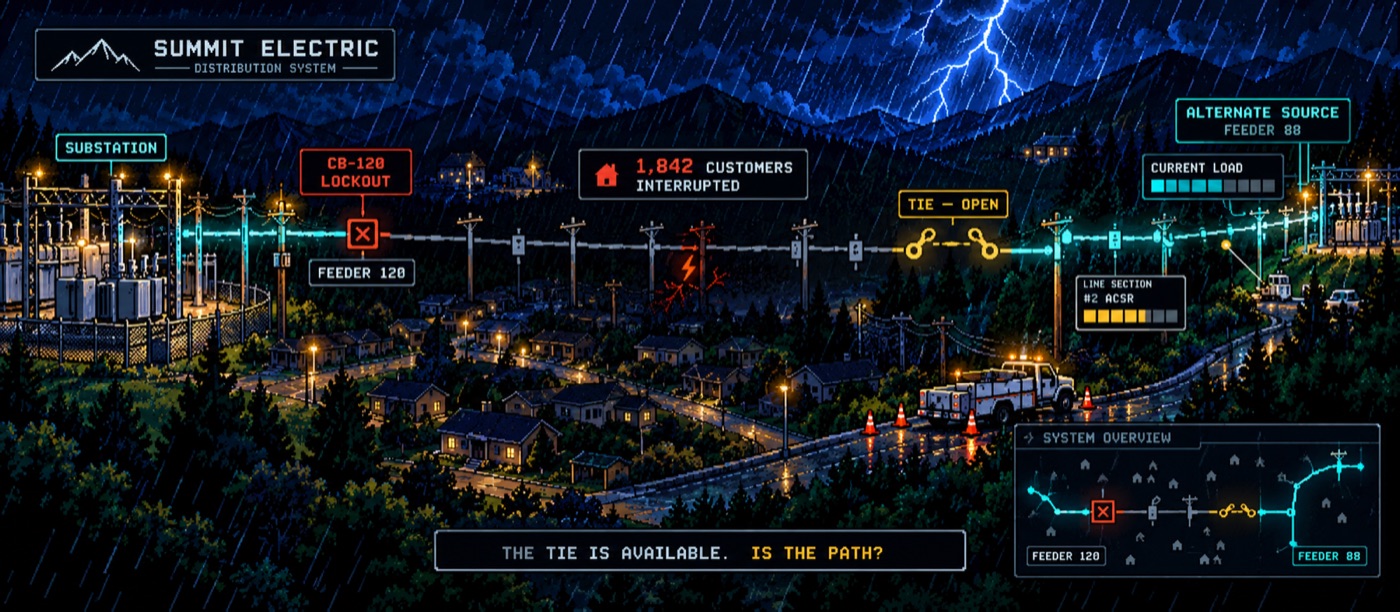
Feeder 120 lockout
- Fault isolated.
- Three alternate restoration paths are available.
- The closest tie is available.
Distribution operator training
Scenario-based proficiency training for electric distribution operations.
GridOps Labs gives developing and experienced operators repeated practice working through restoration, abnormal conditions, conflicting information, loading, system configuration, and competing priorities.
Why repetition
Operators learn an enormous amount on shift: from real events, from mentors, from on-the-job training. That experience can't be replaced.
But the abnormal, rare, and high-value situations don't arrive on a training schedule. An apprentice might go a year without seeing the event that would have taught them the most.
GridOps creates that exposure on purpose, as a repetition layer alongside the training utilities already run.
Public Decision Lab
A feeder locks out on a fictional system. You assess, isolate, restore, and decide. Then you see what your decision did, and why. About 2–4 minutes. No account.
GridOps Field Test
Summit Electric
02:37
Feeder 120 lockout
Storm cell over the east service area.
CB-120 has tripped, reclosed, and locked out.
2–4 minutes · No account needed · Fictional system
The scenario library
50+ scenarios planned across eight operational domains and three difficulty levels. One grid, Summit Grid, with dozens of distinct operating problems — so a rare event isn't the first time an operator reasons through it.
Isolation, sectionalizing, alternate-source restoration, and returning to normal.
Stale indications, telemetry loss, failed control, and SCADA-vs-field disagreement.
Conflicting or incomplete reports, device identification, and crew coordination.
Alarm storms, buried critical alarms, and recognizing system-wide patterns.
Post-transfer loading, equipment limits, and electrically possible but operationally poor moves.
Lockouts, relay targets, recloser behavior, and protection that changes the plan.
Simultaneous events, competing priorities, interruptions, and triage.
Missing or conflicting information, uncertainty, and when not to operate.
How GridOps works
01
Foundational concepts, terminology, and equipment behavior — delivered as structured digital learning built with Articulate 360 and Rise 360.
02
Apply those concepts on the desk inside a Decision Lab: grid state, SCADA, field reports, alarms, loading, and a real operating decision.
03
See what changed and why — the information available, what was assumed, the consequence, and the competency the scenario exercised.
Concept learning can be delivered through Articulate 360 and Rise 360; the Decision Labs and Summit Grid are GridOps Labs' own practice environment.
What we train
Each Decision Lab looks for evidence in a few of these. No single scenario measures any of them on its own.
The training environment
Summit Grid is GridOps Labs' fictional electric distribution training environment, operated by a fictional utility, Summit Electric.
It's intentionally simplified where simplification helps learning. It isn't based on any one utility's SCADA, ADMS, maps, procedures, or equipment identifiers.
That's what lets the reasoning transfer. Complexity is added progressively: training views first, then more realistic operating views with ratings, alarms, and competing information.
We don't teach one utility's control system. We train the thinking behind the work.
Information provenance
GridOps labels information by how the operator knows it — not as a ranking of trust, but to make it obvious what a decision is actually resting on. It's a habit that holds up on a bad night.
For utility training teams
Give apprentices repeated exposure to situations they might not see on shift for months.
Keep qualified operators practiced on the decisions that don't come up often.
Work through equipment that doesn't behave as expected, without the system at stake.
Run a lab as a group, pause at the decision, and let the room argue it out.
Add a repetition layer alongside your existing qualification path.
Keep operator judgment moving with the new tools, not a step behind them.
Short, focused practice in the weeks between scheduled simulator time.
Use the replay as a shared starting point for a real conversation.
You're the operator
02:37
Summit Electric